
Baking Soda for Weight Loss: Does It Work, Is It Safe, and How Much Is Too Much?
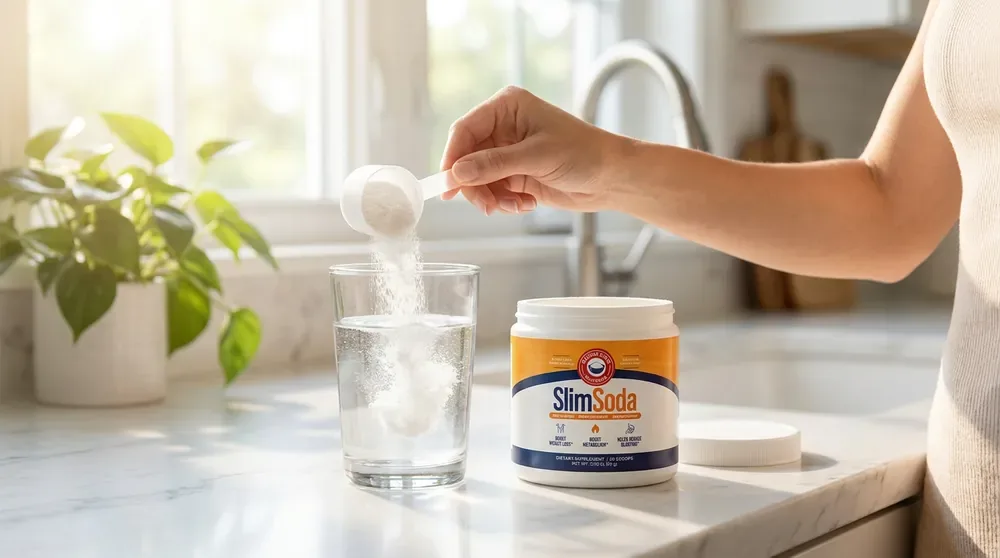
Quick answer. The habit is a good one — a glass of water and something in it, every morning. The problem is the spoon. Baking soda is 27% sodium by weight, so one teaspoon carries about 1,260 mg against a 2,300 mg daily limit, and a kitchen spoon is not a measuring instrument. The version worth doing is a measured dose alongside ginger and berberine, which are the two ingredients here with pooled human data.
You’ve seen it going around. A spoonful of baking soda in a glass of water, maybe with lemon, first thing in the morning.
Searches for it have climbed more than tenfold in three months, and what people type gives away what they’re doing: recipe, shot recipe, what is the recipe. Almost nobody is shopping. Almost everybody is making it at home.
The instinct is right. The spoon isn’t.
Baking soda neutralises acid. That’s what it does in a cake, in your stomach, and in the box that’s been in kitchens for a century. From there it’s a short hop to “if it balances things out, maybe it helps me hold less weight.”
And one part of the ritual genuinely does something: a big glass of water before eating takes the edge off appetite. That belongs to the water, not to what you stirred into it.
What doesn’t survive contact with the evidence is the spoonful itself — and specifically how much of it.
What the research shows
Sodium bicarbonate isn’t obscure. It’s been studied in people for decades, just never for the thing it’s now going viral for.
Where it has been tested, the effect is small. Its established use is buffering acid during hard exercise. A 2025 systematic review with meta-analysis of randomised, double-blind, placebo-controlled trials (Miller and colleagues, Journal of the International Society of Sports Nutrition) found negligible benefit even for running performance.
Stomach upset is a pattern, not bad luck. A 2026 systematic review in the European Journal of Sport Science catalogued gastrointestinal symptoms across supplementation protocols.
Too much has a documented ceiling. A 2026 case report in the American Journal of Emergency Medicine describes severe metabolic alkalosis and high blood sodium from excessive intake. That’s why “a bit more should work better” is the wrong instinct with this one.
Two ingredients in the same conversation do have pooled data. A 2025 GRADE-based dose-response meta-analysis in Complementary Therapies in Medicine assessed ginger against obesity indices in adults, and a 2026 meta-analysis in the International Journal of Obesity did the same for berberine. Gradual, not dramatic — but measured in people, for this outcome.
The sodium arithmetic
This is the part the recipes leave out, and it’s the whole reason to care.
| Sodium in baking soda | about 27% of its weight |
| Half a teaspoon | roughly 600 mg of sodium |
| One teaspoon | roughly 1,260 mg |
| FDA daily limit | 2,300 mg for adults |
So a full teaspoon is over half your day’s sodium before breakfast. And a heaped kitchen spoon can hold nearly twice a level one — hundreds of milligrams you never counted.
Nobody sets out to overdo it. The recipe going around just doesn’t come with a scale.
Who should check with a doctor first
- You take blood pressure or heart medication — the sodium works directly against what it’s for
- You have kidney disease — sodium and bicarbonate handling is exactly what struggles
- You’re on a sodium-restricted diet for any reason
- You’re pregnant or nursing
And promptly, if you get persistent nausea, swelling, muscle weakness, confusion or an irregular heartbeat after taking bicarbonate.
The version that keeps the habit and drops the guesswork
Keep the morning glass. It’s the unmeasured spoonful that’s the problem, not the routine.
SlimSoda Powder is that idea with both weak points fixed. The bicarbonate is portioned into a scoop instead of eyeballed, so the sodium is a number you know. And it doesn’t travel alone — ginger and berberine come with it, which are precisely the two compounds in this whole conversation that have been pooled and measured in people.
Same thirty seconds, same glass. Just nothing left to the spoon.
Questions people ask
Does baking soda actually make you lose weight?
No trial in people has shown that. What’s been studied is exercise performance, and even there a 2025 meta-analysis found negligible benefit. Scale changes people report are more plausibly the large glass of water before eating, plus the other habits that usually start at the same time.
Is it safe to drink baking soda every day?
The risk is the dose, not the substance. A teaspoon carries around 1,260 mg of sodium — more than half the FDA’s daily limit before you’ve eaten. A measured amount is a different situation from scooping by eye, which is the whole reason the home version is the risky one.
How much baking soda is safe to take?
There’s no established supplement dose for weight loss, because there’s no weight-loss evidence to base one on. If you take blood pressure medication, have kidney or heart disease, or follow a low-sodium diet, this is a conversation with your doctor before it’s an experiment in your kitchen.
What about the baking soda and lemon version?
The lemon doesn’t change the sodium arithmetic, and no trial has tested the combination for weight. If the appeal is the morning-drink habit, that part is genuinely worth keeping — it’s the unmeasured bicarbonate riding along that isn’t.
Which ingredients here do have human evidence?
Ginger and berberine. A 2025 dose-response meta-analysis assessed ginger against obesity indices in adults, and a 2026 meta-analysis in the International Journal of Obesity did the same for berberine. Both work gradually — but unlike bicarbonate, both have been measured in people for this outcome.