
Sonnus Gummies Complaints, Pros and Cons: Most Users Report Waking Up Clear Instead of Flattened
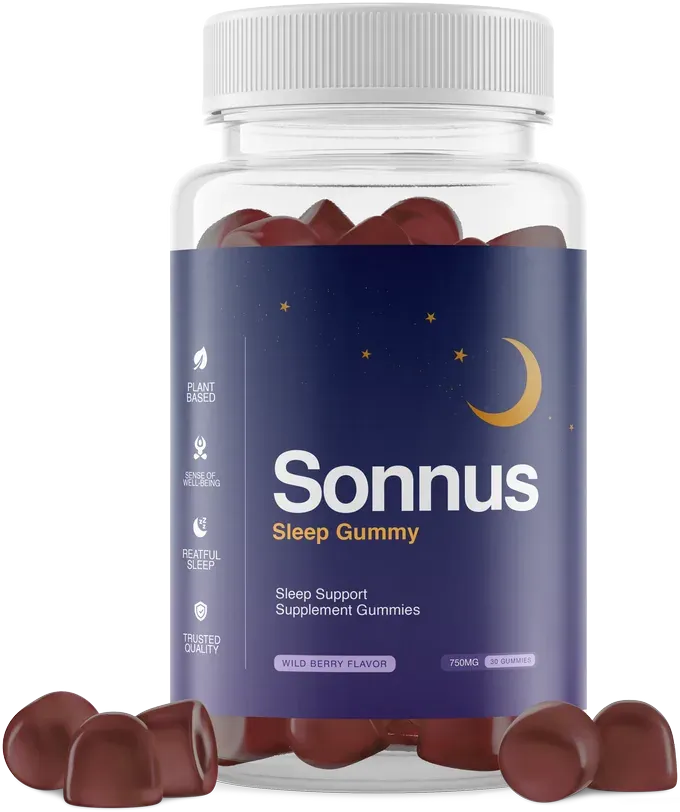
Quick answer. The praise is about mornings, not nights — buyers report waking clear rather than flattened, which is what a 0.9 mg melatonin dose buys you. The complaints are consistent too: two gummies a night makes a bottle 15 nights, and the disappointed accounts are mostly from the first week. Skip it if you take an antidepressant without asking your doctor first.
Most sleep products get judged on the night. This one gets judged on the morning.
That’s the thing that surfaces again and again in buyer accounts, and it isn’t what the label leads with. People don’t write in to say they fell asleep faster. They write to say they woke up and felt like a person — no fog, no hangover, none of the flattened hour that a 10 mg melatonin leaves behind.
Which makes sense once you look at the dose. There’s 0.9 mg of melatonin in here, roughly a tenth of what a typical shelf bottle gives you.
The pattern across buyer reports
| What buyers focus on | The recurring pattern | What it tells you |
|---|---|---|
| The morning, not the night | Waking clear instead of drugged is the most repeated observation, and it comes from buyers rather than the label | It’s the direct consequence of the low melatonin dose. If you’ve quit a sleep aid because of how the next day felt, this is the complaint the formula answers |
| The 3 a.m. wake-up | Shorter, or stops being an event — but later than the morning effect, generally after the first couple of weeks | The two effects arrive on different schedules. Judging by night three measures nothing |
| When people give up | The disappointed accounts cluster in the first week | Nights one to three are deliberately undramatic. That’s the design, and it’s also the moment people decide it isn’t working |
What buyers praise
- The morning. Clear rather than flattened — the single most repeated observation
- Magnesium bisglycinate at the base, with a 2025 placebo-controlled trial behind it
- 0.9 mg melatonin: a night signal, not a sedative
- No added sugar and no stimulant anywhere in it
- A gummy rather than a capsule, which matters more than it sounds at bedtime
- Third-party tested batch by batch, 90-day guarantee
What buyers complain about
- Two gummies a night, so a 30-count bottle is 15 nights — the packages cost more than they look
- Nights one to three are quiet, and that’s where people quit
- 5-HTP is a real interaction with antidepressants, not a formality
- If falling asleep is your problem rather than staying asleep, this isn’t aimed at you
Discounts Available on the Manufacturer's Page →
Skip it if…
Every product is wrong for somebody. Here’s who this one is wrong for:
- You take an antidepressant. 5-HTP raises serotonin, and stacking it with an SSRI, SNRI or MAOI is a genuine interaction. Ask your prescriber before ordering — this one is not a disclaimer.
- Your problem is falling asleep, not staying asleep. The formula deliberately keeps melatonin low, which is the opposite of what sleep-onset products do.
- You’ll judge it on night three. The first nights are undramatic by design. The morning effect shows up in week one or two; the 3 a.m. change comes later.
- You’re pregnant or nursing.
- You drive at night or work shifts — 0.9 mg is low, but it’s still melatonin, and you should know how you respond before relying on it.
Worth it for whom?
For the person whose night has two halves and only one of them counts: asleep by eleven, awake at three, done sleeping at four. That’s the specific complaint this is built around, and it’s the one most sleep products ignore.
For anyone who quit a stronger sleep aid because of the mornings. The 0.9 mg dose exists precisely because the research on melatonin timing and dose found that more isn’t better — and the buyer file reads like confirmation.
And for the person who wants magnesium with something behind it. The bisglycinate form is the one used in the 2025 trial, not the cheaper oxide that turns up elsewhere.
Questions people ask
Why do people say the morning is the difference?
Because that’s where a big melatonin dose costs you. Products at 5 or 10 mg get you to sleep and leave a flattened hour or two the next day. At 0.9 mg there isn’t enough to produce that, which is why buyers describe waking clear — and why it’s the observation that repeats most.
What's the most common reason people are disappointed?
They stopped in the first week. Nights one to three are deliberately undramatic — there’s no knockout dose in here to make them otherwise — and that’s exactly when people conclude nothing is happening. The morning effect tends to arrive in week one or two, and the 3 a.m. change after that.
Is a gummy as good as a capsule?
For a bedtime product it’s arguably better, and not for a technical reason: it’s easier to keep doing. The trade-off is honest — two gummies a night means a 30-count bottle lasts 15 nights, so the cost per night matters more here than the price on the bottle.
Can I take it with an antidepressant?
Not without asking your prescriber. The 5-HTP in this formula acts on serotonin, and combining it with an SSRI, SNRI or MAOI is a real interaction. Of everything on this page, this is the one that genuinely needs a conversation before you order.
What if it doesn't work for me?
There’s a 90-day money-back guarantee on every package, and it’s a one-time purchase with nothing renewing. Ninety nights is also roughly how long a fair test takes, so the guarantee covers the trial rather than running out first. Buy through the authorized seller; that’s where the refund window exists.
Read next: the full review or what it costs.
This review was developed based on these references:
- Schuster J, et al. “Magnesium Bisglycinate Supplementation in Healthy Adults Reporting Poor Sleep: A Randomized, Placebo-Controlled Trial.” Nature and Science of Sleep. 2025. pubmed.ncbi.nlm.nih.gov/40918053
- Cruz-Sanabria F, et al. “Optimizing the Time and Dose of Melatonin as a Sleep-Promoting Drug: A Systematic Review of Randomized Controlled Trials.” Journal of Pineal Research. August 2024. pubmed.ncbi.nlm.nih.gov/38888087
- Mah J, et al. “Oral magnesium supplementation for insomnia in older adults: a Systematic Review & Meta-Analysis.” BMC Complementary Medicine and Therapies. April 2021. pubmed.ncbi.nlm.nih.gov/33865376